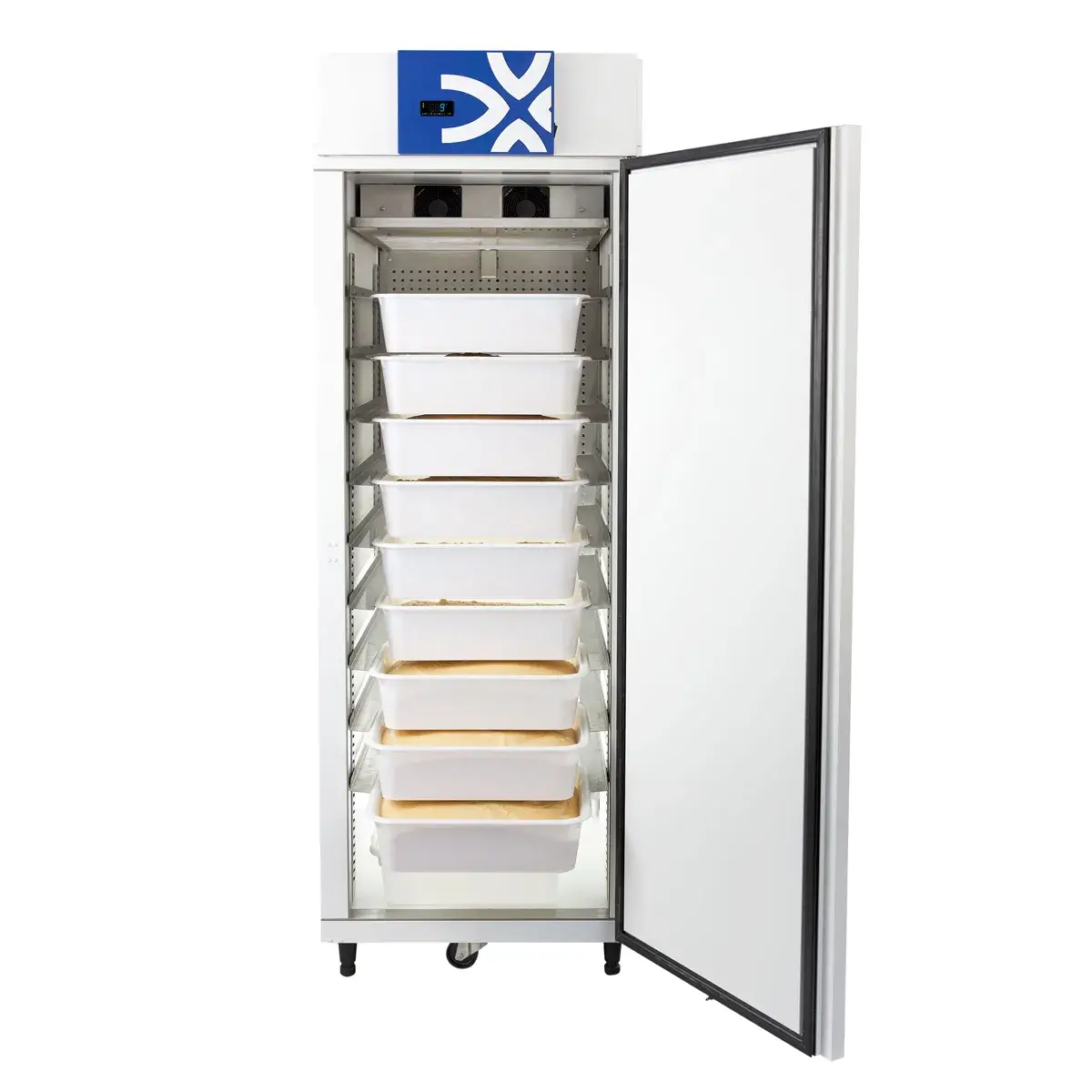


Description
The gentle ventilation allows for progressive fermentation that respects the products and does not alter them. Fermentation is optimal and prevents crusting, without even having to cover the products.
The insulation thickness and its density allow you to reduce your energy consumption by 7 to 10%. In addition, R455 gas refrigeration has an extremely low environmental impact (GWP = 148), making this cabinet an ecological and sustainable solution.

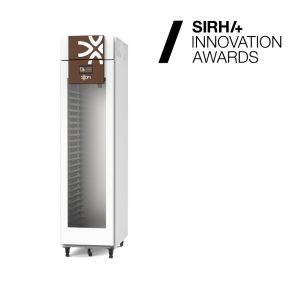
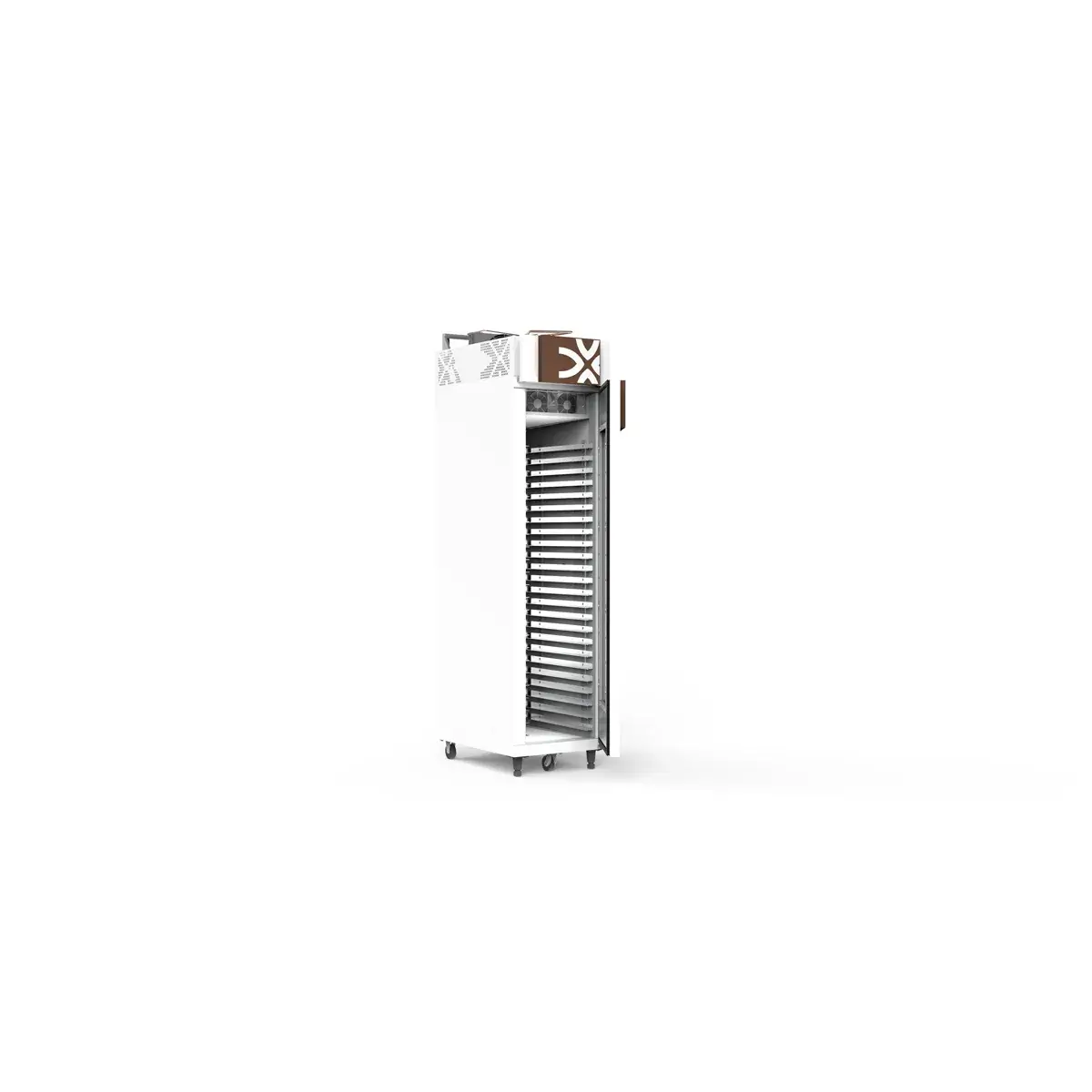
The COCOON cabinet is available in white or stainless steel finish for a sleek and elegant look.
2 models: model 46 and model 68.
Technology:
- CFI for climate: R455 gas refrigeration (GWP = 148)
- Reinforced insulation (polyurethane foam 43kg/m3)
- Defrost cycle by ventilation.
Dimensions
- MODEL 46:
- 2 x 18 levels* for 400x300x75 mm trays
- 18 levels* for 400x600x70 mm trays
- 9 levels for 530x410x140 mm trays
- MODEL 68:
- 2 x 18 levels* for 400x600x70 mm trays
- 2 x 9 levels for 530x410x140 mm trays
Design
- Stainless steel (optional)
Frequently Asked Questions
What refrigeration equipment is essential for a bakery and pastry business?
Working in a bakery and pastry business requires several types of refrigeration equipment. The most obvious is controlled proofing equipment (proofing room or cabinet), which allows doughs to rise and be ready to bake exactly when needed. This equipment adapts closely to the desired process: direct proofing, slow proofing, controlled proofing over 24 or 48 hours…
Next, you need positive (chilled) and negative (frozen) storage equipment to keep raw materials as well as semi-finished and finished products. These units are usually sized according to the volume of product to be stored (refrigerated cabinets, cold rooms, refrigerated pastry counters). Finally, do not overlook the water chiller and its associated water dosing unit, which allow you to control dough temperature and the base temperature of your bread and Viennese pastry recipes.
How does refrigeration affect the quality of bakery products?
Maintaining the correct proofing temperatures preserves aromas, textures and freshness. Bread fermentation is directly affected by temperature and by the length of exposure to that temperature, which transforms the taste of the bread. Temperatures and times must therefore be precise, and only good-quality equipment can deliver that precision. Humidity is also essential: it helps control dough texture as well as the exchanges between the inside of the dough and the surrounding atmosphere, which influence flavor. For positive (chilled) storage, the benefit is obvious: stable temperatures keep fragile products fresh for longer.
How can I optimize the energy consumption of my bakery production area?
Choosing high-quality, well-insulated equipment (minimum foam density of 42 kg/m³) with low energy consumption and suited to your needs reduces the impact on your energy bill. Equipment must be cleaned and serviced regularly, and the condition of the insulated panels should be checked periodically to prevent air leaks, mainly caused by worn door gaskets.
How should I maintain and service my refrigeration equipment?
It all starts with cleaning: in a bakery, flour and ambient humidity create a highly aggressive acidic environment for equipment. This is also why stainless steel equipment, or equipment with anti-corrosion treatment such as cataphoresis-coated evaporators (an anti-corrosion chemical process), should be preferred. Cleaning must be carried out regularly to eliminate all sources of contamination. It should be done with clean water or non-aggressive products, and without tools that could scratch or damage the equipment (pressure washers, metal scourers…). Regular preventive maintenance, with inspections by technicians and monitoring of operating parameters (temperature, condensation), limits breakdowns and reduces energy consumption. Cleaning the hot side of the refrigeration unit, the condenser, is essential to maintain the equipment’s performance.
Why choose equipment made in France?
Short supply chains promote reliability, a lower environmental impact and fast after-sales service, while supporting local industry. They also guarantee fast delivery of spare parts and proven expertise, shaped by a market as demanding as French bakery and pastry.
What are the eco-friendly trends in commercial refrigeration?
The use of natural refrigerants with a low global warming potential (GWP), energy optimization and a commitment to local manufacturing are the most sought-after solutions today.
What innovative features do modern units offer?
Electronic control (displays, microprocessors), remote monitoring and connectivity are now standard for optimized management. The major current innovation is CFI’s long-term storage system for par-baked bread. (See EVER BLUE)
Which finishes should I choose for my equipment?
A white exterior finish offers very good value for money but requires careful cleaning to remove visible marks. A stainless steel exterior finish is more upmarket but harder to keep spotless. It is nevertheless preferred when the equipment is in view of customers.
A white interior finish also offers excellent value for money, whereas stainless steel is more professional and is recommended for use in very high humidity conditions.
Choosing the counter top: a laminating baker (tourier) must choose a granite top in order to “pound” the butter safely. A stainless steel top is better suited to pastry chefs who frequently work with sugar and cream.
Why won’t the humidity level go down in my proofing equipment?
Humidity is a key parameter to adjust during proofing so that the dough can rise without the risk of skinning.
It is important to understand the physical phenomenon behind relative humidity, which is the air’s capacity to hold water vapor. At 20°C, dry air is generally at 40%, sea air at 80% and tropical air close to 90%. At 100% relative humidity, the air becomes a cloud, as the water vapor turns into tiny liquid droplets.
Warm air naturally has the capacity to hold more water vapor before it becomes saturated and droplets form (the same ones that fog up a car windshield). Relative humidity therefore varies with temperature. As soon as it gets colder, this invisible gaseous moisture becomes visible as the temperature drops. The relative humidity level, i.e. the percentage of moisture in gaseous form, rises and approaches 100%, since cold air can hold less of it.
Proofing equipment is generally fitted with a humidification system to increase the humidity of the atmosphere. However, it does not operate at the same time as the refrigeration unit, which would freeze this water instead of keeping it in gaseous form.
On the other hand, proofing equipment has no dehumidification system, because it is difficult to remove vapor once it is present in the air, even more so as the temperature drops. It is therefore not possible to lower the humidity in proofing equipment without replacing the inside air with drier air.
Are there custom solutions for specific needs?
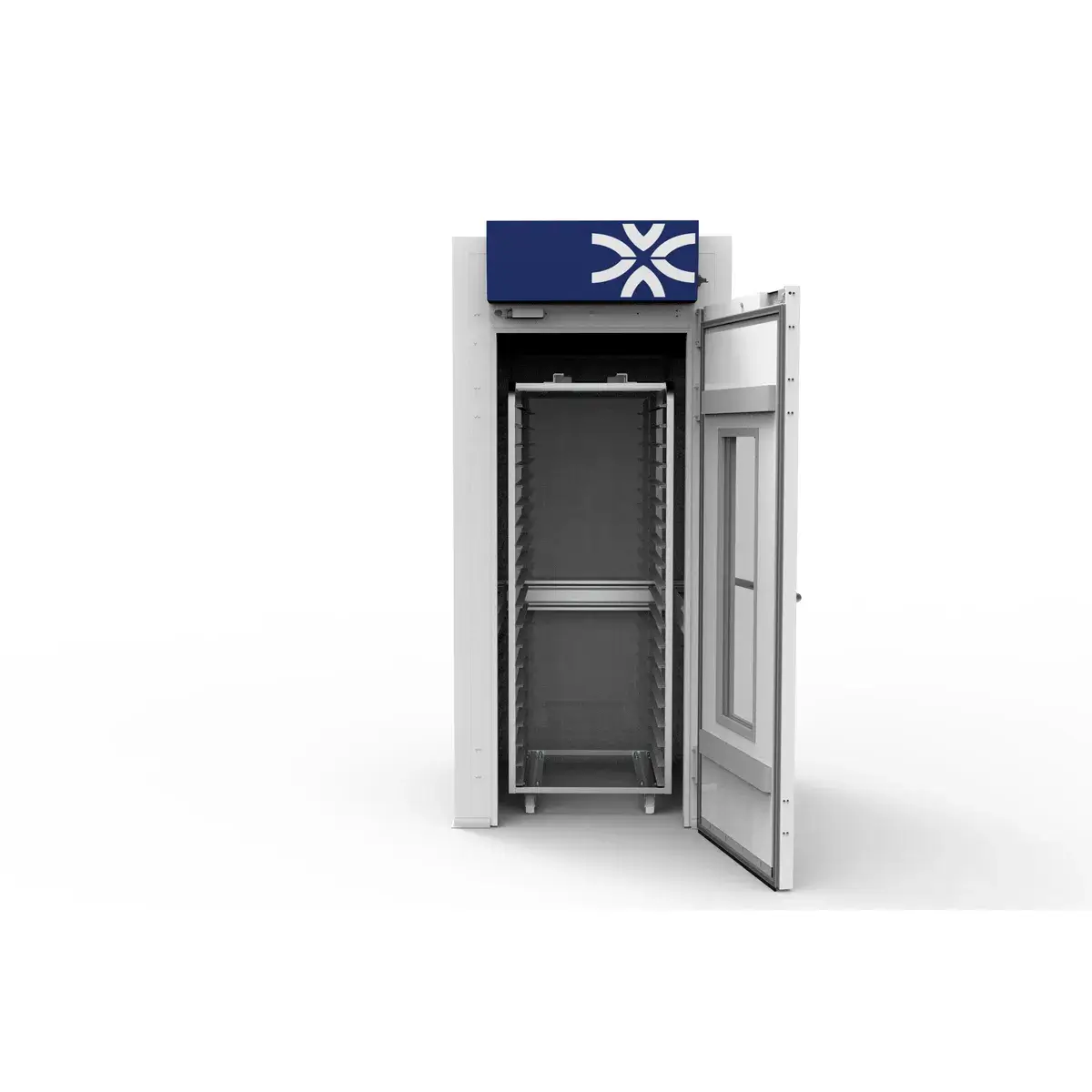
CFI equipment is largely modular and can therefore be adapted to every constraint: available floor space, volume, type of production, etc. For example, proofing rooms are available for 1 to 12 rack trolleys, refrigerated pastry counters can be configured with 2 to 6 doors, and blast freezer-storage units are modular from 2 to 10 doors. Many configurations are possible to suit every bakehouse.